GEOCHEMISTRY FOR MINING, TAILINGS & METALLURGICAL WASTE MANAGEMENT
Turning Chemical Complexity into Predictive Clarity and Long-Term Environmental Confidence
Mining and mineral processing remain the foundations of modern infrastructure, technology, and the energy transition. But with that benefit comes responsibility. The same extraction and beneficiation processes that deliver metals and critical minerals also generate waste rock, tailings, and process residuals that, if not properly managed, can release acidity, metals, and salts to surrounding water and ecosystems long after active operations end.
At WET, we recognize that every mine site has a unique geochemical fingerprint — defined by its ore mineralogy, processing chemistry, hydrogeology, and climate. These factors control how oxygen, water, and microbes interact with sulfides, carbonates, and secondary minerals — determining whether a system stabilizes naturally or evolves toward acid rock drainage (ARD) and metal leaching (ML).

Base- and precious-metal ores naturally occur with sulfide-bearing minerals such as pyrite (FeS₂), chalcopyrite (CuFeS₂), and sphalerite (ZnS). To recover these economically valuable metals, large quantities of rock must be mined, generating two primary waste byproducts:
- Waste Rock: Coarse, unprocessed material removed to access the ore during open-pit or underground mining.
- Mill Tailings: Fine-grained residue remaining after ore processing and metal extraction.
Both waste streams often contain residual sulfide minerals and are typically stored onsite in subaerial waste facilities, including dry-stack tailings or waste-rock piles.
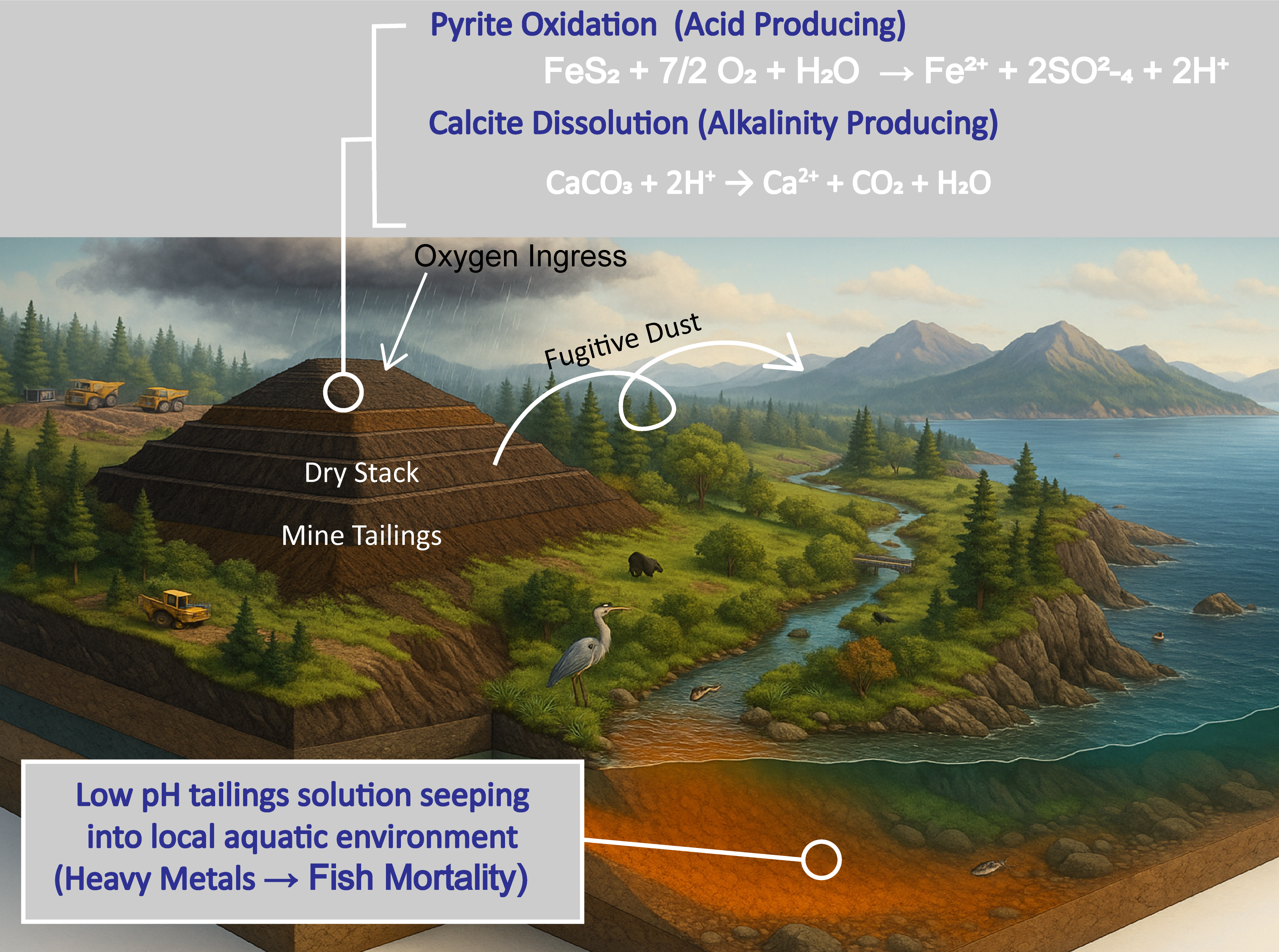
When exposed to oxygen (O₂) and infiltrating meteoric water, these materials undergo a series of acid-generating oxidation reactions that mobilize metals into solution. Oxygen diffusing into pore spaces reacts with sulfide minerals, producing sulfuric acid and ferric iron — triggering a cascade of redox, dissolution-precipitation, and adsorption–desorption reactions as water migrates through the pile.
FeS₂ + 3.75 O₂ + 3.5 H₂O → Fe(OH)₃ + 2 SO₄²⁻ + 4 H⁺
The resulting drainage, known as Acid Rock Drainage (ARD) or Acid Mine Drainage (AMD), can exhibit pH values as low as 2.0, often enriched in iron, manganese, zinc, copper, nickel, and other trace metals. When drainage chemistry remains near-neutral but still transports dissolved metals, it is referred to as Metal Leaching (ML) — a related process governed more by mineral dissolution and desorption than acidity alone.
Together, ARD and ML represent the most persistent environmental legacy of hard-rock mining. Acidic and metal-rich waters emerging from mine wastes can degrade surface water, groundwater, and soils, affecting aquatic life, vegetation, and long-term closure compliance.
At WET, we quantify, model, and predict these reactions — transforming chemical uncertainty into defensible understanding — so our clients can design, monitor, and maintain mine-waste systems that remain chemically stable, environmentally sound, and regulator-approved for decades to come.


Whether designing new facilities or closing legacy waste repositories, WET’s geochemists specialize in transforming complex chemistry into clear, defensible insight.

We integrate field instrumentation, major-ion and trace-metal chemistry, isotopic systems, and microbial and gas analyses to trace reactions, quantify oxidation and neutralization rates, and forecast water quality through time.
By characterizing each material’s chemical, mineralogical, and biological signature, WET distinguishes natural geologic background from mining-related impact — mapping reactive zones, evaluating cover and seepage performance, and verifying long-term containment integrity.
From feasibility to final closure, WET bridges the science between resource development and environmental stewardship, ensuring that the legacy of production is one of predictability, compliance, and confidence.

WET deploys a comprehensive suite of geotechnical and hydrogeochemical tools to evaluate how reclamation covers perform under real-world climate and hydrologic stress:
- Vibrating-wire piezometers and tensiometers to track suction, pore pressure, and hydraulic response to precipitation and freeze–thaw cycles.
- Electrical conductivity and volumetric-moisture probes to monitor infiltration, storage, and permeability contrasts between cover layers.
- Suction lysimeters to collect pore-water samples for dissolved metals, anions, alkalinity, and redox species.
- Soil-gas sampling tubes and in-situ gas analyzers for O₂, CO₂, and CH₄ to quantify oxidation and respiration fluxes.
- Temperature and frost sensors to link thermal gradients with oxygen diffusion and saturation changes.
- Reactive-transport modeling (PHREEQC, Geochemist’s Workbench) to simulate acid–base reactions, mineral precipitation, and gas diffusion.
These datasets confirm whether a cover acts as an oxygen barrier, a capillary break, or a reactive buffering medium —critical for dry-stack tailings where infiltration and gas flux control long-term performance.