GEOCHEMISTRY FOR OIL, GAS, BRINE ENERGY PRODUCTION
Turning Chemical Insight into Regulatory Clarity and Environmental Confidence

Oil and gas production remains a cornerstone of modern energy security — driving transportation, manufacturing, and economic growth. But with that benefit comes responsibility. The same processes that extract and process hydrocarbons also generate produced water, saline brines, and hydrocarbon residuals that, if not properly managed, can impact groundwater, surface water, soils, and ecosystems.
At Water & Environmental Technologies (WET), we understand that every energy site has a distinct geochemical signature — shaped by its reservoir lithology, structure, hydrodynamics, and operational history. These factors govern how brines, hydrocarbons, and gases migrate through the subsurface, often producing complex chemical and isotopic fingerprints that obscure the line between natural and industrial sources.

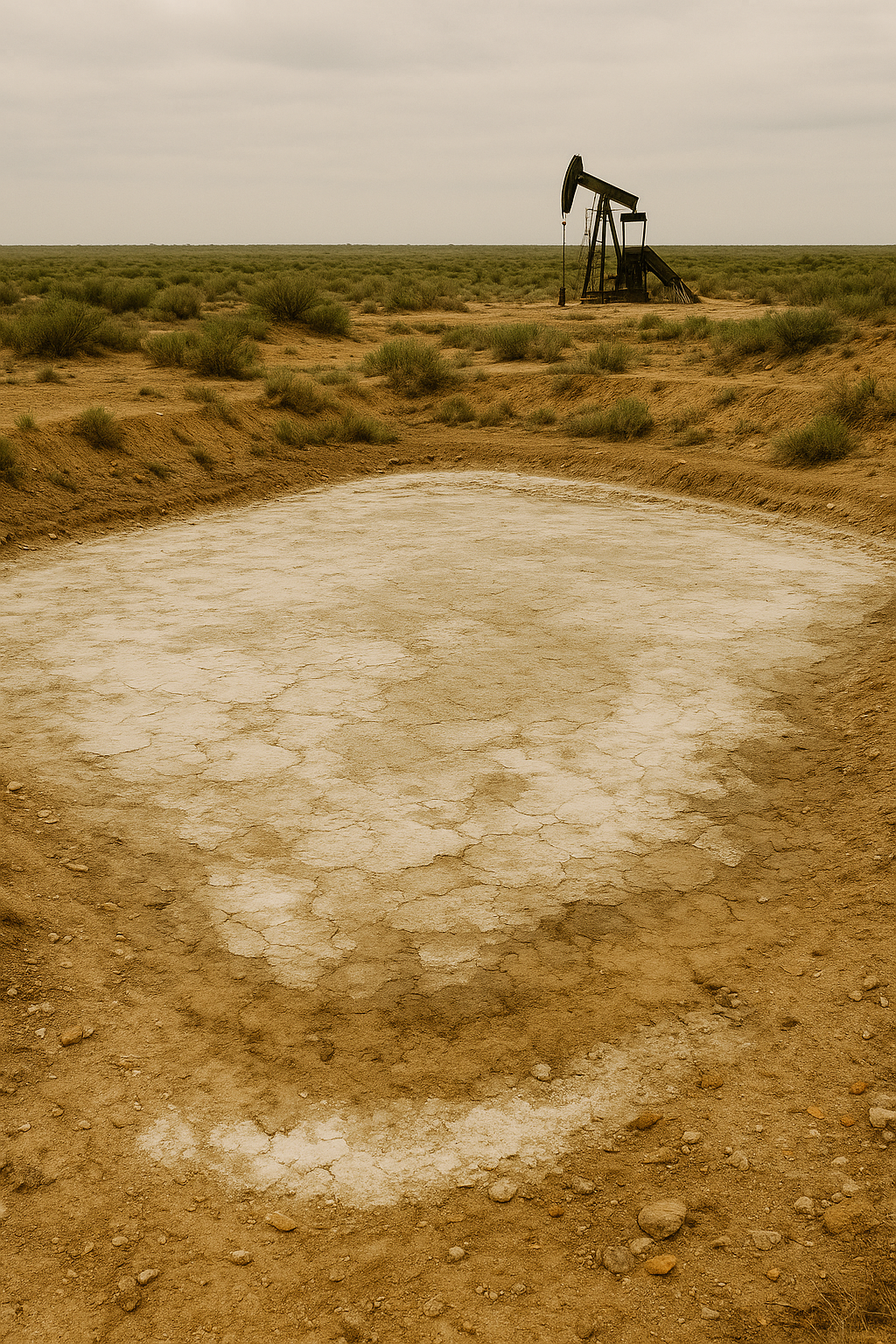
Whether supporting active recovery and reinjection operations or addressing legacy contamination from unlined brine pits and abandoned wells, WET’s geochemists specialize in transforming chemical uncertainty into clear, defensible evidence.
WET integrates major-ion chemistry, isotopic systems, hydrocarbon gases, and noble gases as geochemical tracers to resolve the origin and movement of saline fluids — distinguishing natural formation water (the deep, geologic background brine) from anthropogenic releases that occur either at the surface (such as leaks from pits, tanks, and pipelines) or within the subsurface (such as well-casing failures, injection-zone communication, or legacy wellbore leakage). By characterizing each fluid’s unique chemical and isotopic fingerprint, WET maps migration pathways and confirms containment integrity across both active and legacy energy sites.
From produced-water discharge compliance to post-closure verification of historic oilfields, WET bridges the science between energy production and environmental stewardship.


- Produced-Water and Brine Differentiation—Identify and apportion salinity sources using major-ion ratios (Cl/Br, Na/Cl, SO₄/Cl) and isotopic systems (⁸⁷Sr/⁸⁶Sr, δ⁷Li, δ¹¹B, δD–δ¹⁸O). Distinguish natural formation signatures from produced water mixing or surface contamination.
- Hydrocarbon Gas and Noble Gas Tracing—Characterize gas origin, migration pathways, and reservoir connectivity through hydrocarbon isotopes (δ¹³C–δD in CH₄, C₂H₆, C₄H₁₀) and noble gases (He, Ne, Ar, Kr, Xe). Noble gas ratios reveal the age and depth of fluids and separate deep thermogenic gases from shallow microbial or meteoric inputs.
- LNAPL/DNAPL Assessment and Management—Move beyond mapping to decode the chemical evolution, partitioning behavior, and long-term stability of immiscible fluids. WET’s geochemists integrate isotopic characterization, dissolution and biodegradation modeling, and reactive-transport analysis to quantify how LNAPLs and DNAPLs evolve in the subsurface — informing recovery strategies, natural attenuation potential, and risk evaluation with defensible, process-based evidence.
- Hydrocarbon Source and Migration Forensics—Apply compound-specific isotope analysis (CSIA) on δ¹³C and δD in CH₄, BTEX (Benzene, Toluene, Ethylbenzene, and Xylenes), and PAHs (Polycyclic Aromatic Hydrocarbons) to differentiate thermogenic vs. microbial hydrocarbons, confirm biodegradation, and apportion mixed releases.
- Legacy Brine Pit and Injection-Well Characterization—Evaluate long-term impacts of unlined pits, reinjection zones, and failed casings. Model the fate of reactive and conservative species using PHREEQC, Geochemist’s Workbench, and GoldSim.
- Fate and Transport Modeling—Integrate hydrogeologic, reactive, geochemical, and isotopic data to simulate contaminant evolution, predict risk to receptors, and support closure and performance verification.
- Regulatory Integration and Risk Management—Align technical findings with EPA Underground Injection Control (UIC), RCRA, and state oil-and-gas programs, producing regulator-ready documentation grounded in defensible science.



From modern energy production to legacy oilfields, WET turns chemical insight into environmental certainty — balancing the realities of regulation, restoration, and community trust.
Our mission is simple: to ensure that energy production and environmental protection coexist sustainably, transparently, and scientifically.
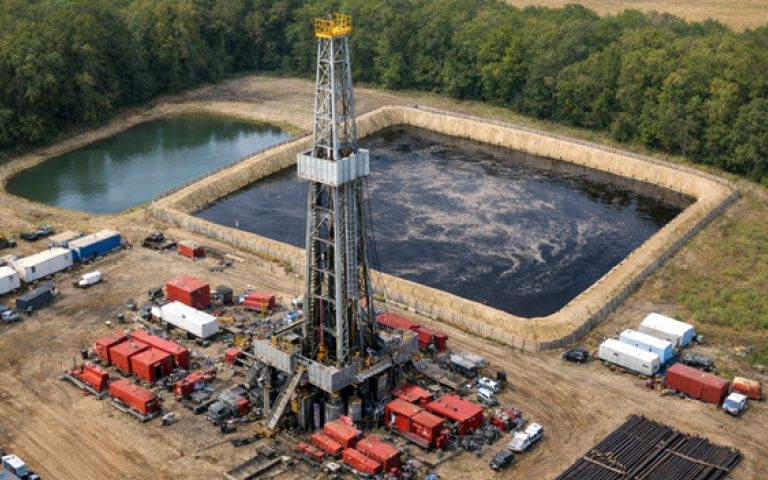

A comprehensive multi-tracer geochemical investigation — performed under the U.S. EPA CCR Rule, RCRA imminent-and-substantial-endangerment provisions, and Clean Water Act prohibitions on unpermitted discharges — was completed to resolve groundwater and soil impacts associated with decades-old brine-disposal operations. The assessment confirmed that all historical unlined brine pits were actively and continuously leaching, and it identified a separate produced-water release migrating into farmland aquifers, threatening both agricultural irrigation networks and down-gradient public drinking-water supplies. By integrating major- and trace-element chemistry with strontium and lithium isotopes, dissolved hydrocarbon gases, and noble-gas fingerprinting, the investigation clearly differentiated wastewater impacts from natural formation signatures and traced fugitive thermogenic gas pathways with high confidence. Advanced geochemical modeling using PHREEQC and Geochemist’s Workbench simulated equilibrium and kinetic water-rock interactions, validating plume evolution and strengthening regulatory defensibility. Together, these converging lines of evidence provided the landowner with clear source attribution, a defensible corrective-action framework, and decisive technical support during remediation negotiations. The findings played a central role in litigation that resulted in a $15 million remediation settlement, enabling long-term protection of agricultural lands and public water resources while significantly reducing future environmental impacts.
LET’S CONNECT
Brad Bennett, PG
bbennett@waterenvtech.com
John Trudnowski, PE
jtrudnowski@waterenvtech.com

“Clarity through chemistry—ensuring every regulatory decision is backed by data.”